
Pick an injury and walk through the visit the way a provider would: checking for a fracture or something in the wound, then closing, support, and medicine for pain, swelling and infection, with specific options and doses at each step. Each injury also lists template lines to check and restriction wording. Each choice shows how OSHA counts it, and the result builds as you go.
Over-the-counter medicines count as first aid at the strength on the over-the-counter label, even when a provider hands them out or writes them on a prescription. Anything stronger, and every prescription medicine, counts as medical treatment, even one dose and even if the prescription is never filled.
Four questions OSHA’s rule asks about every visit
If the answer to any of these is yes, the case is recordable. If every answer is no, it’s first aid. Tests, X-rays, rechecks and advice don’t change the answer.
- Was a prescription medicine recommended or given? Including an over-the-counter medicine above the single dose on its label, and a prescription that’s never filled.
- Was anything done that isn’t on OSHA’s first aid list? Such as stitches, skin glue, a rigid splint, physical therapy, an exercise program, or any shot other than tetanus.
- Was a fracture, a chipped or broken tooth or a punctured eardrum diagnosed, or did the person lose consciousness? These are recordable at diagnosis, whatever the treatment.
- Is the employee off work after the day of injury, or kept from a routine job task? A routine task is one done at least once a week.
The one-page cheat sheet lists every item on OSHA’s first aid list. The quiz uses lines from real-world work notes, including the traps that come from note templates.
Common questions about OSHA first aid and recordable cases
Does a visit to a provider make a work injury recordable?
No. A visit to check an injury, tests and X-rays aren’t medical treatment under OSHA’s rule. What was done or recommended at the visit decides whether the case is recordable.
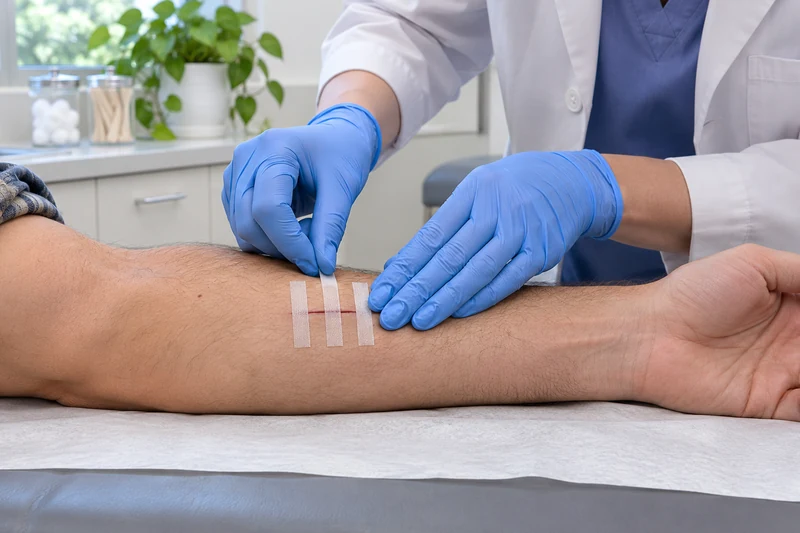
Are Steri-Strips first aid?
Yes. Butterfly bandages and Steri-Strips are on OSHA’s first aid list. Stitches, staples, skin glue such as Dermabond and zipper-style closures count as medical treatment.
Is 800 mg of ibuprofen recordable?
Yes. 800 mg is above the single dose on the over-the-counter label, so OSHA counts it as a prescription-strength medicine, even when it’s given as four 200 mg tablets. Over-the-counter ibuprofen at the label dose is first aid.
Does a splint make a case recordable?
A rigid splint used to hold a body part still counts as medical treatment. Splints used only to move a patient, elastic wraps and other non-rigid supports are first aid.
Is kinesiology tape first aid?
Used for support, yes: OSHA treats it as a non-rigid support. Used to hold a cut closed, it’s a wound closure, and closures other than butterfly bandages and Steri-Strips count as medical treatment.
How does “work as tolerated” count on the OSHA log?
On its own, it’s too vague to tell. OSHA says to ask the provider what it means, and to record restricted work if you can’t get an answer. When the note adds limits, like a rest break every 30 minutes, OSHA counts it as restricted work.
Is a tetanus shot recordable?
No. A tetanus shot is on OSHA’s first aid list. Other shots, such as a pain shot, count as medical treatment.
Does this guide tell providers how to treat?
No. Every patient should get the care that’s medically right for them. The guide only shows how OSHA’s rule counts each option, and the employer decides what goes on its OSHA log.
OSHA’s rules decide how a case is logged, never what care an employee gets. This guide is general information based on OSHA’s recordkeeping rule, not medical or legal advice. Check with a safety or legal advisor about a specific case. Sources: OSHA, 29 CFR 1904.7, including the complete first aid list in 1904.7(b)(5)(ii) and (iii), prescription medicines used only to diagnose in 1904.7(b)(5)(i), recommended treatment in 1904.7(b)(5)(v), days away and restricted work in 1904.7(b)(3) and (b)(4), including vague restrictions in 1904.7(b)(4)(vii), loss of consciousness in 1904.7(b)(6) and significant diagnoses in 1904.7(b)(7); OSHA recordkeeping FAQ 7-4 (restrictions that leave every routine task possible), FAQ 7-5 (skin glue), FAQ 7-6 (IV fluids), FAQ 7-7 (finger guards), FAQ 7-8 (prescription-strength doses of over-the-counter medicines), FAQ 7-11 (splinters), FAQ 7-15 (oxygen) and FAQ 7-17 (chipped or broken teeth); OSHA interpretation letters of August 8, 2002 (liquid bandage), August 26, 2004 (glue, prescription antibiotics and antiseptics), June 26, 2013 (reducing a dislocation), July 6, 2015 (kinesiology tape), December 21, 2017 and November 14, 2018 (cold compression), September 13, 2018 (rigid braces and splints; epinephrine), May 8 and July 28, 2009 (oxygen), September 7, 2010 (“work as tolerated” with rest breaks), April 24, 2006 (record what actually happens), May 23, 2019 (massage) and October 9, 2019 (ZipStitch and Clozex); contaminated needlesticks and sharps in 1904.8 and privacy cases in 1904.29(b)(7); OSHA interpretation letter of November 12, 2015 (broken or chipped teeth); OSHA’s 2024 enforcement guidance on recommended exercise.
From OneSpotMD, treating work injuries for Charlotte employers for about 7 years. See our workers’ comp injury care, the OSHA recordable injury guide for employers, or the TRIR, DART and EMR calculator.